What do Vietnamese think about Vietnam today?
From Refugee Memories to Startup Dreams: Vietnam Through Vietnamese Eyes
When I left my homeland of Vietnam for the U.S. in 1991, the country had very little international trade. Consequently, the economy was not yet robust; inflation soared to 700%, and farmers lived in poverty. Business activities were confined entirely to the domestic market. However, over time, the Vietnamese government adopted a fresh, more open diplomatic perspective, welcoming foreign investors into the country. This shift paved the way for the emergence of numerous businesses, both large and small. These changes have brought about significant transformations in Vietnam over the past 50 years, affecting both domestic and foreign affairs. The economy has grown stronger and more sophisticated, attracting international tourists and generating substantial economic benefits. Given these many developments, I find myself wondering what people—both at home and abroad—think of the country today.
A large number of young people within the country are turning toward entrepreneurship. According to data from Mekong Capital, private enterprises and home-based businesses (mostly family-run) in Vietnam contribute 51% of the GDP and provide 42 million jobs. A report by the Associated Press notes that while the average Vietnamese person’s monthly consumption was just 1,200 USD in 1990, that figure has since increased thirteenfold, reaching 16,385 USD. Additionally, many young people from the overseas Vietnamese community are returning to the country to start businesses. The government plans to ease regulations for foreign investors—such as lowering taxes—to make business operations and growth easier.
I had the opportunity to meet a man named Vinh Lê, who had returned to Vietnam from the United States to explore business opportunities. Initially, he opened a coffee shop in Ho Chi Minh City. After a year, he noticed a growing trend of people exercising at gyms. At that time, there were very few gyms in the city, and membership fees were prohibitively expensive. This inspired him to open his own gym; he found an affordable location and set up a facility with lower rates than the competition. Before long, his gym had attracted a large number of Vietnamese and expatriate members. He told me, “Vietnam offers so many business opportunities right now; we just need creativity and patience.” These developments demonstrate that young people view Vietnam’s economic prospects optimistically and are full of hope for the future.
Politically, however, the mention of Vietnam often immediately brings the war to mind. Many older people—particularly former soldiers of pre-1975 South Vietnam now living in the U.S.—harbor lingering resentment toward the communists. Within the Vietnamese American community, many still fly the “Yellow Flag with Three Red Stripes” as a symbol of the Republic of Vietnam and of democratic freedom. They frequently follow news regarding politics, the economy, and daily life in Vietnam to stay informed about current events and to express their desire for democracy in the country.
Nevertheless, the younger generation tends to view Vietnam with a more open and pragmatic attitude than their elders. In my interactions with young people both in Vietnam and abroad, I have found that they regard the Vietnam War as a matter of history—something that is no longer a topic of discussion. Some have said, “We were born and raised in a peaceful country and never gave war a second thought.” In conversations with young people, I found that they view Vietnam as a nation brimming with opportunities for economic growth and believe that people should be more enthusiastic about seizing these chances.
I also had the opportunity to meet Khoa Nguyễn, a 70-year-old Vietnamese man who moved to the U.S. two years ago. He noted, “Vietnam's current president is spearheading a campaign to root out officials involved in bribery and corruption, including high-ranking government figures.” He views this as a significant step toward more effective governance and greater national stability. Most citizens are employed and enjoy a more comfortable standard of living than in the past.
He also mentioned that the transportation infrastructure has improved considerably; roads have been widened, and his commute by private vehicle takes much less time than it used to. Furthermore, the government is investing in a North-South high-speed railway system with a total budget of $67 billion USD, a project designed to cut travel time between Hanoi and Ho Chi Minh City to just eight hours.
Socially, there are slight differences in perspective between the generation born in Vietnam and those raised abroad, such as in the United States. Many born in Vietnam are eager to return and visit their homeland after years of living abroad. Meanwhile, some young Vietnamese Americans travel to Vietnam to explore the country their parents and grandparents left behind to settle in a foreign land—a place that serves as their own second home.
After years of reform, Vietnam has developed across many areas. I have interacted with people who have lived in the U.S. for years, as well as those who have recently arrived from Vietnam. I notice that many acknowledge Vietnam as one of the most dynamic nations in the world. Once an impoverished country, it has risen to become a leading global rice exporter. With economic growth, the people are far less destitute than they were when the communist government first took over the South.
What do Young Vietnamese-Americans Think About Vietnamese?
Between Two Tongues: How Vietnamese American Youth Really Feel About Their Heritage Language
When I was young and unmarried, my father advised me to teach my children Vietnamese once I had them. He believed young people pick up English quickly once they start school, as they constantly interact with friends and teachers—most of whom speak English—and their textbooks are usually written in English. I realized that teaching Vietnamese to one's children in the U.S. is no simple task; children naturally focus more on English, which often leads to a decline in their Vietnamese proficiency. Another crucial factor is whether young people want to learn the language. This question intrigued me most, prompting me to explore how Vietnamese American youths perceive the language, the obstacles they face, and—above all—whether they feel learning it is worthwhile.
I had the opportunity to observe many children in Texas and noticed they were not fluent in Vietnamese, even though some attended language classes at pagodas or churches. One child told me, “I like learning Vietnamese, but instructional materials are scarce”—even in libraries, despite the large Vietnamese community in Texas. Purchasing these materials privately is very expensive. This highlights a significant gap in meeting children's needs.
By contrast, the situation in San Jose, California, for instance, differs from that in major Texas cities. San Jose is home to the largest Vietnamese population outside Vietnam, with the community concentrated in close-knit neighborhoods. Local libraries carry a wide range of Vietnamese books for adults and children. Vietnamese associations in San Jose frequently organize musical performances, social gatherings, and festivals, etc. Consequently, I assumed that many young people there would be highly proficient in Vietnamese.
However, my assumptions prove incorrect; in reality, only a small number of them are fluent. I have had the opportunity to interact with many young people and listen to their views on the Vietnamese language. Some find Vietnamese very difficult to learn because of its pronunciation, the six tones (level, grave, hook, acute, dot, and tilde), and the challenge of distinguishing spoken vocabulary, which can cause them to lose interest in studying it. Others believe that Vietnamese is not widely spoken in the U.S., with one student I’ve talked to arguing that “if I was to learn a language other than English, it should be Spanish,” given the larger Hispanic and Latin American population compared to the Vietnamese community.
In the school environment, many students note that Vietnamese people often speak English; consequently, knowing Vietnamese offers little practical value, and speaking it might make one feel out of place among friends. Others feel their Vietnamese proficiency is poor and fear being mocked by those who are more fluent.
Although some struggle with the language because of these obstacles, others take a different approach: they strive to overcome them and learn Vietnamese, recognizing its importance. When I asked, some replied that “they could communicate frequently with parents, aunts, uncles, and grandparents in Vietnamese.” Furthermore, it enables interaction with the surrounding Vietnamese community, as many older adults do not understand much English. One remarked that “speaking Vietnamese allows for a deeper, more emotional connection than speaking English.” Each greeting, for instance, is different based on who Vietnamese are talking to: “Dạ chào bố mẹ ạ” (respectful greeting to parents), “Dạ chào ông bà ạ” (to grandparents), or “Dạ chào thầy cô ạ” (to teachers). Through these varied forms of address, they learn to greet people across generations and social standings, conveying genuine respect rather than a simple “Hi.”
In another situation, many young people express a desire to visit Vietnam for travel or to see relatives. Some look beyond personal visits, wishing to return to Vietnam to help orphans and the impoverished, particularly children who face great hardship. However, without a solid grasp of Vietnamese, communicating with people in the country would be difficult.
Some young people also want the Vietnamese American community to grow and remain closely united, ensuring that overseas Vietnamese voices carry more weight in the U.S. Additionally, given the current high number of Vietnamese students studying abroad, many believe that fluency in Vietnamese would greatly facilitate communication.
Many young people also wish to preserve Vietnamese traditions and culture. Vietnamese is commonly spoken during major holidays like Tết (Lunar New Year), weddings, family ancestral death anniversaries, etc. Once they understand the language, they come to appreciate Vietnam’s unique customs, such as the legend behind “bánh chưng” (sticky rice cakes), the tradition of “lì xì” (lucky money), and home decorations for Tết, and recognize the importance of preserving them. As one student noted, there is a Vietnamese saying: “As long as the Vietnamese language endures, the nation endures.”
Furthermore, young people raised in the U.S. are often quite proficient in Vietnamese. Some say their families speak Vietnamese and encourage them to do the same; they also often take Vietnamese language classes in high school. I once met a young man whose approach to learning the language truly surprised me. Around age 12, he taught himself using the internet, YouTube, and videos, while also reading Vietnamese books and newspapers. Notably, he mentioned a love for “classic music by legendary singers such as Thái Thanh, Anh Ngọc, Duy Trác, and Sĩ Phú,” a passion that helped him expand his vocabulary. As a result, he became skilled at singing Vietnamese songs and developed strong writing skills. When I asked why he wanted to learn Vietnamese, his answer was simple: “Because I am Vietnamese.”
Vietnamese American youth abroad hold varying perspectives on learning the language. However, in general, they place great importance on it because of their Vietnamese heritage. When I interact with young adults (ages 16 to 30), I find that most are more interested in learning Vietnamese than younger adolescents (ages 11 to 15). In my observation, while family and the environment in which they grow up play a role, learning the language largely depends on young people's own judgment and decisions.
How does Mahjong influence social interaction among Vietnamese?
Why the Best Place to Talk Politics, Health, and Family is a Mahjong Table
I remember that when I was about twelve years old in Vinh Long, Vietnam, my parents often played Mahjong—a game they also called “shuffling the tiles”—with my father's friends at home. At first, I wasn't particularly interested, but after a few months I began to enjoy it and wanted to learn more about how to play. I also played other games, such as “Xập Xám” (Vietnamese Poker), “Chắn,” “Tam Cúc,” and Chinese chess, but I found Mahjong the most fascinating. Although I already knew how to play Mahjong, I later starting paying closer attention to how Vietnamese people interact socially while playing it.
For those unfamiliar, Mahjong originated in the coastal regions of eastern China around the mid-19th century, during the late Qing Dynasty. From then onward, the game spread throughout China and across the globe, reaching the United States, France, the United Kingdom, and Southeast Asian countries. Between 1920 and 1930, as the Chinese community in Cho Lon, Vietnam, flourished, Mahjong gained popularity and became a common pastime among the elite, merchants, and wealthy Chinese residents. Over time, the game spread to the broader Vietnamese population.
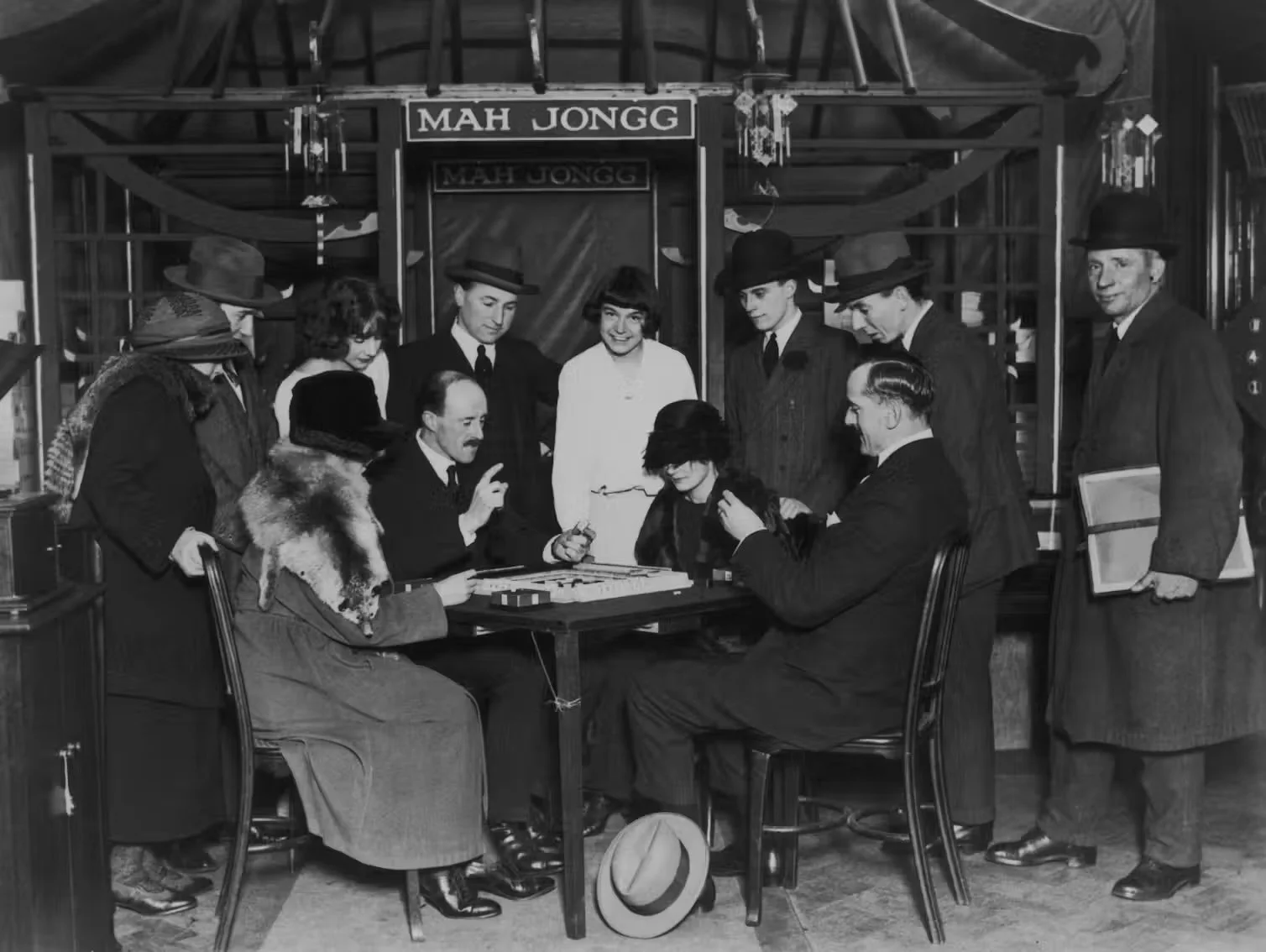
A mahjong class in progress at a Selfridge’s department store in London, circa 1925. Photo by FPG/Hulton Archive/Getty Images
The Chinese version of Mahjong typically consists of 140 tiles, usually made of plastic. However, the Vietnamese version includes additional “flower” tiles and “frame” tiles as jokers for the standard suits—such as the Dots (Văn), Bamboo (Sách), Characters (Vạn), and Winds/Dragons (Tài Phao). This brings the total number of tiles to 160 and adds variety to gameplay. With more “flower” tiles and bonus tiles in the mix, there are greater chances of winning big, and it is easier to manage the game when dealt a poor hand.
Mahjong requires four players. A standard mahjong table measures about 3 to 3.5 feet square, making conversation easy for the four players who sit close together. Beyond the game itself, players often discuss topics unrelated to Mahjong—such as business, politics, healthcare, or social issues—depending on their areas of expertise. I recall my father playing with military officers; they discussed branch-specific military matters. When a doctor was present, the conversation turned to medicine or disease prevention. Once, when my younger sibling had been running a fever for days, a doctor who was playing that day examined them and, at my mother's request, prescribed medication. Often, the players’ wives would accompany them for a visit; while the men played Mahjong, my mother would socialize with the women. This created a pleasant, relaxed atmosphere for my parents and their guests.
Mahjong is enjoyed not only by men but also by many women—my mother included. I have several nieces in Houston, Texas, who are young and love playing the game. This shows that interest in Mahjong spans both older and younger generations. We often play whenever we gather for holidays like the Fourth of July, Thanksgiving, Christmas, and New Year’s. Since we live far apart and rarely see each other, playing Mahjong gives us a chance to catch up on our lives, especially with the younger generation.
I also occasionally visit friends in Dallas, Texas, to play Mahjong. Since we are all retired, our conversations during the game often center on Medicare and money-saving tips. We also discuss politics and the economy, as we frequently keep up with these topics. I also meet new friends and often play Mahjong with them; this fosters a shared interest in getting together and conversing more often.
Mahjong is currently popular across all walks of life, among both men and women. I recently read in The Wall Street Journal that Camp Harlam in Kunkletown, Pennsylvania, has begun teaching children to play. Surprisingly, both the children and the instructors have become truly passionate about the game, often playing all day. One American woman described playing Mahjong with her mother and daughter, calling it a way to bond across three generations. This is no different from what happens in Vietnamese families; I used to play Mahjong with my parents and uncle, and nowadays my wife, child, brother, and I often play together.
As I have mentioned, Mahjong is not merely a form of entertainment but also a means of social connection. It gives families the chance to make new friends, brings relatives closer together, and offers opportunities to learn interesting things. Furthermore, the game fosters greater empathy and understanding among participants.
Why do Overseas Vietnamese Start Small Businesses?
The Real Honest Reason Vietnamese Immigrants Build Shops, Salons, and Restaurants
One of the ways my family and I celebrated America’s 250th anniversary was looking at old family photos—approximately 314 of them. One that caught my eye was a picture of my aunt and me at her bakery shop in Houston, Texas, when I was no more than six years old. She has always inspired me to start my own business, but looking back at this picture, I wonder what inspired her to start her own business. In fact, many of the Vietnamese I knew growing up also had their own small businesses. Their shops, nail salons, and Phở restaurants are plentiful in almost every metropolitan area in the world, especially in America. But what started this trend?
2.
Nguyễn Ngọc Ngạn, the former co-host of the popular live entertainment show “Paris By Night,” once said that, according to Time magazine, the number of self-employed businessmen in America, the wealthiest country in the world, is only 4%. In comparison, Vietnam holds the world record for the number of self-employed at 40%. While the percentages might be exaggerated, there turns out to be some truth to this.
“We Vietnamese have a saying: ‘No trade, no wealth,’” explained Kim Lê, owner of Kim’s Tailoring in San Jose, California. “Back then, nothing beat doing trade. Even now, with a small business, I still earn more money than I would have as an employee.”
The tradition of self-employment came from China, which dominated Vietnam for a thousand years. During China’s domination, the Chinese saying “No trade, no wealth” spread to Vietnam as working in agriculture and industry was not seen as profitable as doing business. This thinking continued throughout Vietnam’s history, but as about 100,000 Vietnamese emigrated on and before April 30, 1975, the collapse of South Vietnam, they tended to attain higher education and therefore a higher-paying job, not needing to start a business. Many of these Vietnamese were or came from the upper class, either already having the resources to escape, connections outside of Vietnam, or were studying abroad.
However, many Vietnamese who came after April 30, 1975, the so-called “boat people,” had a harder time getting higher education and finding a good-paying job. “When I first arrived [in the U.S.], I didn't have any means of making a living,” Kim says. “I had to go to school, which took time. Then there was the question of how to support a household. And if I waited until after finishing my studies to have children, it would have been too late.” Many Vietnamese immigrants like Kim had no option but to forgo higher education and enter directly into the workforce.
But she at least did have a passion for her trade. “I love this profession. From the moment I wake up, my mind is on beautiful clothes—thinking about how to make them look stunning. I’ve had this passion since I was young; I wouldn’t want to do any other job.”
“I was fortunate to bring this trade with me from Vietnam. Because I personally love wearing beautiful outfits and experimenting with different styles, I create clothes that look wonderful on my customers—and they love them.”
3.
Next to where Kim sells and tailors clothes, there is a karaoke shop whose owner, working there nearly every day of the year, also faced many hardships upon immigrating to America. Đoàn Nguyễn, 70-year-old owner of DN Karaoke, “can still place orders and communicate in English. But, for instance, if you were to speak English to me now, I’d have to think for quite a while to understand the sentence.” Consequently, “I never attended a single day of school after coming here; I had to teach myself everything. I even had to learn the technical side of the equipment on my own.” However, unlike Kim, “before I got into this line of work, I wasn’t passionate about it.”
Upon immigrating to America in 1990, Đoàn worked all kinds of jobs—“working a few months at a gas station, followed by another few months at a donut shop”—before finding a job at a karaoke shop. As he worked there for over a decade, he quietly studied the machinery’s inner workings, which turned out to be helpful when “on a beautiful day, the shop there caught fire,” and, with the experience Đoàn accumulated, he thus started his own karaoke shop in 2015. “When starting a business, everything needs a bit of luck.” he remarked.
The struggles Kim and Đoàn had, such as the language barrier and the lack of formal education, also help explain why there are so many Vietnamese-owned restaurants and nail salons. For example, in Houston, Vân Nguyễn opted to start a nail salon because, even with a formal college education, she couldn’t acquire more than a technician-level job. Opening a nail salon to Vân “offered a low barrier” to making more money, not to mention the feeling of stability of not having to worry about being unemployed.
4.
Despite many Vietnamese starting businesses, many don’t have a desire to. Among those less likely to start a family or small business are the younger generation, predominantly those born within or after the 1990s.
“Almost every Vietnamese person wants to start a business,” says Đoàn. “Yet none of my children have any interest in business. For our generation, being in America meant opportunity, whereas our children have grown up enjoying a comfortable life here.”
Along with Vietnamese born outside of Vietnam generally having higher education than Vietnamese immigrants, allowing for better-paying jobs, their jobs also allow for greater freedom compared with being committed to and constantly responsible for starting a business. “My children work eight-hour days, then come home to eat and relax,” Đoàn explains. “On Saturdays and Sundays, they go out and have fun. Living in America, they earn good money and have the time for leisure. One of my children, for instance, just spent three weeks traveling in Japan. Another went to Europe, to France and Germany,” while Đoàn rarely skips a day at his store.
5.
The following Saturday, I called my aunt to ask why she had started her bakery shop. “Honestly, I prefer running my own business,” she reflected, “because I don’t like working under anyone. I’m my own boss. I handle the design and make my own decisions about what I do. I don’t have to depend on others—or follow the policies and rules set by an employer or a boss. It offers much more freedom.”
Freedom is perhaps the greatest motivation for Vietnamese starting their businesses. Kim wanted freedom to pursue her passion for tailoring clothes. Đoàn sought freedom to make more money despite a lack of English proficiency and a college degree. And my aunt pursued freedom to make her own choices. Many of the Vietnamese diaspora members who fled their home country to seek freedom are also those who started their own businesses in hopes of achieving what they had sought in the first place.
How Do Vietnamese Decide Who to Vote for in America?
Here are the Things That will Guarantee a Vietnamese Vote in America
At the dinner table, my extended Vietnamese family talks about the usual topics: how our day went, gossip about a distant cousin, and politics. My uncle Bình and I were talking the other week about how, without America’s generosity in allowing Vietnamese families to arrive throughout the ‘70s and onward, we wouldn’t have had the prosperous life we have now, and our English surely wouldn’t have been as good. We have a lot to thank America for.
For my parents, that Wednesday evening was just another dinner at Uncle Bình’s house, but for me, that day would lead to a revelation. Right as dessert was being served, Uncle Bình suddenly said, “without the president deporting undesirable immigrants back to their own country, we won’t have a safe home.”
The President he is referring to is Donald Trump, whom he voted for in 2020 and 2024, and this is one of many mismatches I often hear in the Vietnamese community between what Vietnamese people believe in and who they actually vote for. Why don’t Vietnamese vote for what they actually value?
This thought led me on a months-long quest to discover how past experiences, generational differences, and external factors influence Vietnamese voting.
2.
In searching for why Vietnamese vote the way they do, one Vietnamese refugee put it most clearly: “We want someone that stands with us against communism.” This Vietnamese refugee, 77-year-old Hải Vũ, was a high-ranking military officer in South Vietnam, fighting the Northern communists while being injured three times. Born in the North, he escaped its communist regime under Hồ Chí Minh in 1954 and came to the South Vietnamese capital, Sàigòn.
A film he remembers watching vividly mirroring his own experiences, “Chúng Tôi Muốn Sống” (Let Us Live), filmed a year after the war started erupting in 1955, describes the cruelty of communists toward their people and follows the protagonist named Vinh, who makes the dangerous escape by boat to South Vietnam to escape death and search for freedom. Many of these victims, similar to Vinh and Hải, would end up immigrating to the United States.
Upon the fall of Saigon in 1975, while many were able to leave Vietnam successfully, Hải’s attempted escape led to the communists putting him in a “re-education camp,” where he was tortured and forced to do labor. The anti-communist sentiment he grew up in followed him as he finally came to the U.S. in 1992 and settled in Houston, Texas, a privilege granted to many high-ranking military officers by Bill Clinton, who normalized diplomatic relations with Vietnam in the 1990s.
If Bill Clinton allowed Hải to attain his freedom in America, wouldn’t Hải support Clinton and the Democrats? “I believe that fighting communism is the most important thing I stand for,” he exclaimed, “and Democrats like control and big government, just like the communists. The way [the communists] controlled us in the North and in prison was inhumane and dictatorial. That’s why I vote Republican. It’s worth sacrificing welfare for the bigger goal.”
In fact, Vietnamese are the only Asian-American group whose majority leans toward Republicans.
There’s another reason why Vietnamese uniquely lean Republican that Hải identified: the Democratic Congress in 1973 denied Nixon’s proposal to support South Vietnam with funds and ammunition, therefore making the Communists’ victory “inevitable.”
One of the opponents to Nixon’s Vietnam-funding plan was Joe Biden, who forty years later would run for President against one of the more popular Presidents of the Vietnamese community, Donald Trump. Trump is, in fact, popular enough that Vietnamese Orange County residents flew a Trump 2020 flag in a drive-by demonstration, and the Hồn Việt Choir in Houston made a video encouraging people to get out to vote for the president in 2020. “Trump definitely doesn’t like socialism or communism. He fights for freedom and democracy. He brings a lot of jobs back to America,” says Bach Hac, a member of the choir.
3.
Tuấn Phạm, an economic refugee who came to the U.S. in 1982 when he was 21 by escaping on a boat in the middle of the night to Malaysia, also agrees with Hải on Democrats acting too much like communism and believes that the Democratic Congress betrayed his country. When the Northern regime took over the South in 1975, Communist officials took the assets Tuấn’s family had and put them into poverty, receiving no more than two bowls of sand-filled rice per day and sharing it among Tuấn’s two elderly parents, one older brother, one older sister, and three younger brothers. Before retiring, he worked on the assembly line in San Jose, California, where many of his colleagues were also Republicans.
Yet despite supporting Republicans, Tuấn currently relies on Medicare, Medicaid, and other Democrat-supported government programs in California. “I think healthcare is also important,” Tuấn commented, “but I think immigration and anti-communism matter more.” While his wife supports Democrats for their welfare policies, wives typically support, even convert to, their husbands’ political views, including Hải’s wife.
But not all Vietnamese support Republicans. Younger Vietnamese Americans lean Democratic: 88% of Asian Americans aged 18-29 identify as Democrats.
4.
Sophie Nguyễn, raised in Oklahoma City and currently a junior at the University of California at Los Angeles, supports Democrats. “There’s not really a reason anymore to be scared of communists,” she remarked. “That’s a thing of the past.” Instead, she values Democratically-favored policies such as less restrictive abortion and LGBTQ rights and stricter gun control. “My Vietnamese friends and I are all liberal, and I think people at UCLA are as well.”
28-year-old Naomi, also in Los Angeles, further shared, “The younger generation here, at least in Southern California, lean more liberal” and believes “strategies to protect and value humanity, our environment, and the Earth are so necessary.” Influenced by the election of the first man of color to hold the office of President, the #MeToo movement, the Black Lives Matter movement, and her local community, Naomi believes Democrats align more with her and her friends’ values. “We need to allow people to be their own individuals and express themselves and who they are. When [Trump] tries to villainize, make people small, and take away rights that we truly deserve as humans, it’s incredibly disheartening.”
As more young Vietnamese-Americans attain voting age, we are starting to see the overall Vietnamese population shift toward Democrats. For the first time, in a mid-2024 poll, more Vietnamese voters lean Democratic than Republican. The poll also indicated a 28% drop in Vietnamese support for Trump compared to 2020.
5.
There’s one more key factor in influencing who the Vietnamese vote for. Huy Đào came to America in 1991, where he had a sponsor in San José. In 2004, like many other Vietnamese, Huy voted for Republican Bush Jr. for President because “[the Democrat] John Kerry was anti-Vietnam War and friendly with the Communist Hà Nội,” and for John McCain in 2008 because “he was a prisoner of war and hero in the Vietnam War.”
Nevertheless, he hadn’t been interested in politics a whole lot, though he had “been watching mainstream news like CNN, ABC, and CBS back then.” Despite voting for Republican Presidential candidates twice and his conservative beliefs, he identified as a Democrat. “The Democrats promised to take care of low-income and newcomers financially,” he said. In 2016, Huy voted for Democrat Hillary Clinton “because I thought Trump was just a businessman. I didn’t know any better.”
Then something changed inside of him. “In 2018, on TV and Facebook, I saw illegal immigrants from Mexico climb the border, and President Trump tried to stop them to protect America. But the Democrats and the Congress wanted to prevent him from doing the right thing. From then on, I became MAGA.”
With his decision to support Trump, Huy began to doubt what he was watching. “Even the mainstream media were saying bad things about Trump,” Huy said, “and so when I started watching Fox News, I stopped watching mainstream media because Fox News is better.” Now, when he gets home from work, Huy goes to his computer and watches conservative-leaning videos on social media. “I like to watch Fox News, Newsmax, and the [Vietnamese] YouTubers the most. They all tell the truth.”
Some researchers argue that the political information many older Vietnamese consume on social media, such as Facebook and YouTube, often contains misleading, opinionated, or even false information from independent reporters with little or no political background.
In contrast, younger Vietnamese are also influenced by social media in making political decisions, but in different ways. Among Naomi’s friends, for example, “Instagram was pretty big. And that was really interesting because it got more young people into politics because we were seeing it on our phones so constantly.”
The difference in social media’s influence between different Vietnamese voters “really depends on its algorithm,” Naomi explains. “If you lean more conservative, the algorithm pushes you more that direction; if you lean more liberal you get pushed more liberal and even more to the extreme. It’s causing this divide in politics where it's feeling like we can't reach a middle ground because we're exposed to both ends of the spectrum in a drastic way.”
6.
As our family was just about to leave for the night, I asked Uncle Bình about how he decides who to vote for. “It’s about their attitude,” he reflected, “Trump’s an outsider, not a corrupt politician or part of the Deep State. He has common sense that aims to truly help us, not just for his own benefit. The Democrats and RINOs [Republicans against Trump] follow the Communists and Socialists and not for America. That’s why they open up the Mexican border so communists can come in in exchange for votes. That’s why Joe Biden and Nancy Pelosi are very rich.”
When I got in the car, Uncle Bình opened his mouth as if to say something, and, after a few moments of pause, he continued: “I think the way we vote in America has to do with our past experiences, especially experiences with communism, what our local community values, and what media we watch.”
Note: Some of the people I’ve interviewed for this article requested anonymity. Therefore, to protect their identity, I’ve given the following pseudonyms: Hải Vũ, Tuấn Phạm, and Sophie Nguyễn.